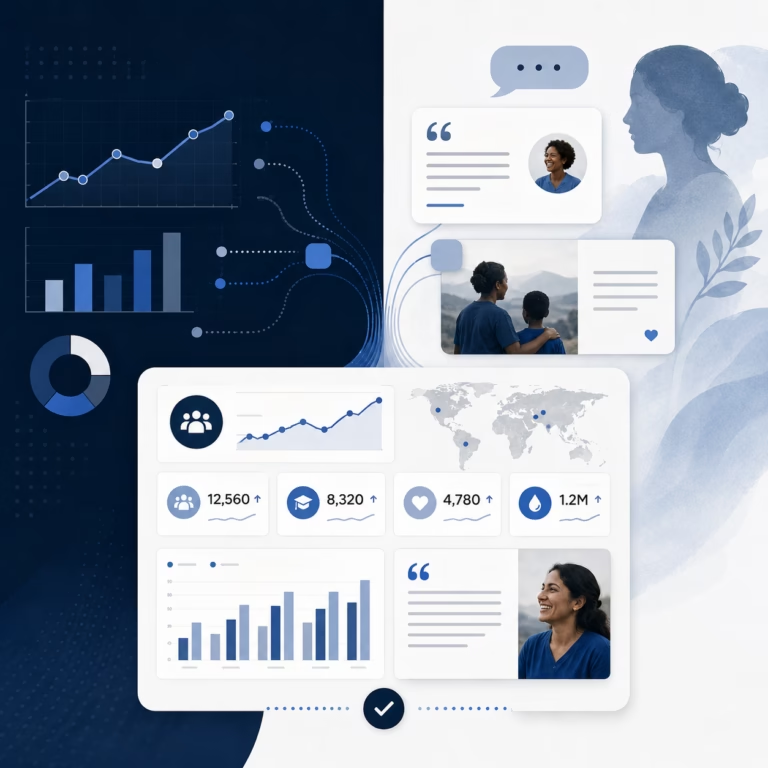
A nonprofit report can be accurate and still fail to land.
The numbers may be correct. The charts may be clean. The outcomes may be real. But if the report does not help people understand what the work meant, it can feel flat.
The opposite is also true.
A powerful story can move people, but without data, it may not show scale, consistency, or progress.
That is why strong impact reporting needs both.
Data shows what happened.
Stories show why it matters.
Numbers alone do not carry the full message
Data is essential. It gives leaders and funders a way to see scale, compare progress, and understand whether work is moving in the right direction.
But numbers rarely explain the full value of nonprofit work by themselves.
A number can show that 400 people participated. It may not show what changed for them.
A KPI can show that completion increased. It may not explain what made that progress meaningful.
A chart can show growth over time. It may not reveal the human reality behind that growth.
Data gives the report credibility. Stories give it meaning.
Stories alone are not enough either
Stories matter because nonprofit work is human work.
They show experience, context, trust, dignity, challenge, and change in ways that numbers cannot. They help boards, funders, donors, and partners understand the value of the work beyond the metric.
But stories need structure too.
If stories are collected randomly, saved in emails, remembered by staff, or pulled together only when a report is due, they become hard to use. They may be powerful, but they are not connected to the goals, programs, outcomes, or funding they help explain.
That is where many nonprofits lose value.
They have stories. They have data. They just do not have a clear way to connect them.
The strongest reporting connects evidence and meaning
Good impact reporting should answer three questions:
What happened?
What changed?
Why does it matter?
Data helps answer the first two. Stories help answer the third.
A stronger report does not treat stories as decoration at the end. It connects them to the same structure as the data.
For example:
A program has a goal.
The goal has KPIs.
The KPIs show progress.
A story shows what that progress looked like in a real person’s experience.
A grant or board report connects both into one clear picture.
That is more credible than a number alone and more disciplined than a story alone.
A practical test for your reporting
Look at one report your organization produces regularly.
Then ask:
- Do the numbers clearly connect to goals or programs?
- Do the stories support the same goals or outcomes?
- Can you explain why each story was selected?
- Are stories captured throughout the year, or searched for at the last minute?
- Can funders and board members see both scale and human value?
- Does the report help leaders understand what to continue, change, or strengthen?
If the answer is no, the issue is not storytelling ability.
It is structure.
What better looks like
A stronger approach treats stories as part of impact infrastructure.
That means the organization knows:
- Which stories should be captured
- Which goals or programs they connect to
- Which outcomes they help explain
- Who is responsible for collecting them
- How consent, privacy, and sensitivity are handled
- How stories are used in board, funder, donor, and leadership reporting
This does not make storytelling mechanical. It makes it usable.
The goal is not to turn human experience into a data point. The goal is to make sure the human value of the work is not lost, scattered, or remembered only when someone needs a quote.
Where Elroos Technology fits
Elroos Technology helps nonprofits connect impact data and impact stories into a clearer reporting structure.
The work helps organizations define what needs to be tracked, how programs and outcomes connect, where stories should be captured, and how both quantitative and qualitative evidence support reporting, decision-making, and communication.
For organizations using Track Impact Now, this structure can be managed in one system by connecting goals, programs, grants, KPIs, and impact stories together.
That connection matters.
It helps nonprofits move from reporting activity to communicating impact.
Bottom line
Data and stories should not compete.
They do different work.
Data shows scale, pattern, and progress. Stories show meaning, context, and human value. Together, they create stronger reporting and a more credible picture of impact.
Nonprofits do meaningful work every day.
The challenge is making that work visible in a way that is both clear and human.
