AI is tempting because it promises speed.
Summarize this. Draft that. Find patterns. Create a report. Analyze the data. Turn notes into insights.
For nonprofits, that promise is appealing. Teams are stretched. Reporting takes time. Staff are carrying too many manual processes. Leaders need clearer information faster.
But AI does not remove the need for structure.
It depends on it.
If the goals are unclear, AI will not know what matters. If the data is inconsistent, AI will summarize inconsistency. If workflows are messy, AI may just make the mess move faster. If governance is missing, AI can create risk before it creates value.
AI can help. But only when the foundation is clear.
AI is not a shortcut around operating discipline
A nonprofit may want AI to help with grant reporting, board summaries, donor communications, program analysis, or impact stories.
Those are reasonable use cases.
But each one depends on basic operating clarity.
What information is approved for use?
Which data is sensitive?
Who reviews AI-assisted output?
Which reports need human judgment?
Where do stories come from?
What should never be entered into a public tool?
How will staff know when AI is appropriate and when it is not?
Without those answers, AI adoption becomes a collection of experiments. Some may be useful. Some may create risk. Most will not scale.
That is not strategy. That is tool use without a model.
The real question is readiness
Before asking, “Which AI tool should we use?” nonprofits should ask, “Are we ready to use AI responsibly?”
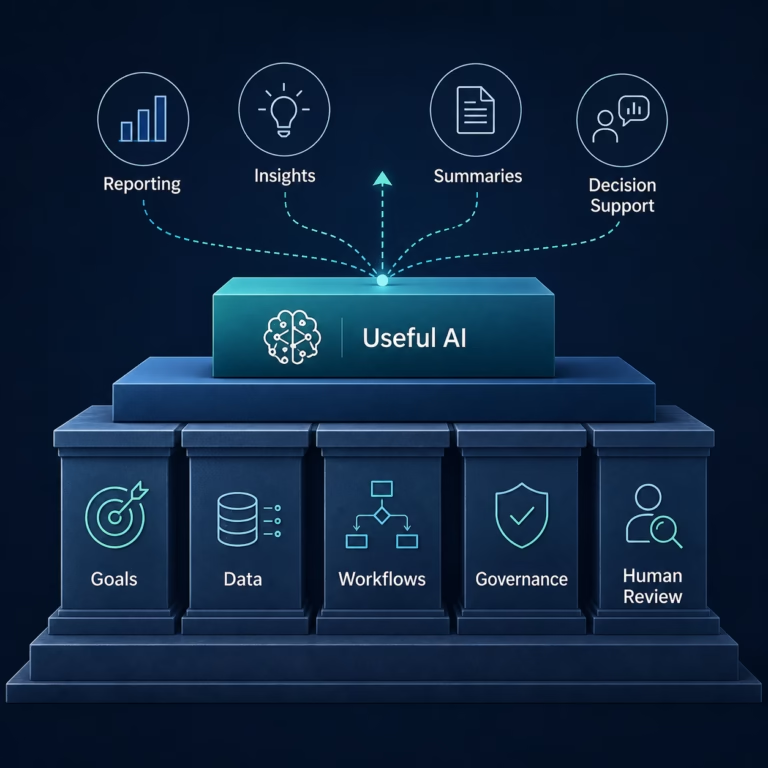
That means looking at five areas.
1. Goals
AI needs direction. The organization should know what it is trying to improve: reporting speed, impact story analysis, workflow support, grant preparation, decision support, or something else.
If the goal is vague, the result will be vague.
2. Data
AI is only as useful as the information it can safely and appropriately use. The organization needs to understand where data lives, what can be used, what should be protected, and what is reliable enough to support AI-assisted work.
3. Workflows
AI should fit into real work. It should not create a separate side process that staff have to manage on top of everything else.
The question is simple: where does AI reduce friction without weakening quality or accountability?
4. Governance
Responsible AI needs clear boundaries. Staff need to know what is allowed, what requires review, what data is off limits, and who approves new use cases.
Governance should not be heavy. It should be clear.
5. Human review
AI can assist. It should not become the final authority.
For nonprofit impact work, human review matters because context matters. A board update, grant narrative, or impact story is not just content. It represents people, programs, funding, and organizational credibility.
A practical AI readiness test
Here is a simple test for nonprofit leaders.
If a staff member used AI today to help prepare an impact report, could your organization clearly answer these questions?
- What information can they use?
- What information should they not use?
- What output requires review?
- Who is responsible for accuracy?
- What source data should the output be based on?
- How will the final report be checked?
- Does the use case support a real reporting, workflow, or decision need?
If those answers are unclear, the organization is not fully ready. That does not mean AI is off the table. It means readiness work should come first.
What useful AI adoption looks like
Useful AI adoption is focused.
It starts with practical use cases, not broad ambition.
Examples may include:
- Summarizing program notes into themes
- Drafting a first version of a board report narrative
- Identifying common patterns in impact stories
- Helping staff prepare grant reporting summaries
- Creating internal briefing drafts from approved information
- Supporting workflow documentation and knowledge capture
These are not flashy use cases. That is the point.
The best early AI use cases are usually the ones that reduce real friction, protect quality, and make existing work easier to manage.
Where Elroos Technology fits
Elroos Technology helps nonprofits approach AI through readiness, governance, and practical value.
The work starts by clarifying goals, data, workflows, reporting needs, ownership, and risk. From there, AI use cases can be identified and prioritized based on what will actually help the organization execute, report, decide, and communicate more clearly.
This keeps AI in the right place.
Not as the strategy.
Not as a shortcut.
Not as a disconnected experiment.
AI becomes one supporting capability inside a stronger impact infrastructure model.
Bottom line
AI can help nonprofits work faster, see patterns, and reduce manual effort.
But it cannot replace unclear goals, weak data discipline, broken workflows, or missing governance.
The organizations that get the most value from AI will not be the ones chasing every new tool. They will be the ones that build the foundation first.
Clear goals. Trusted information. Practical workflows. Responsible guardrails. Human review.
That is where useful AI begins.
