Many nonprofits hear “data strategy” and immediately picture something too large, too expensive, or too technical for their organization.
A data warehouse. A dashboard project. A full analytics team. A long implementation plan. A consultant asking for documentation that does not exist.
That is not where most nonprofits need to start.
Most need something simpler and more useful.
They need practical data discipline.
The problem is not always a lack of data
Most nonprofits already have data.
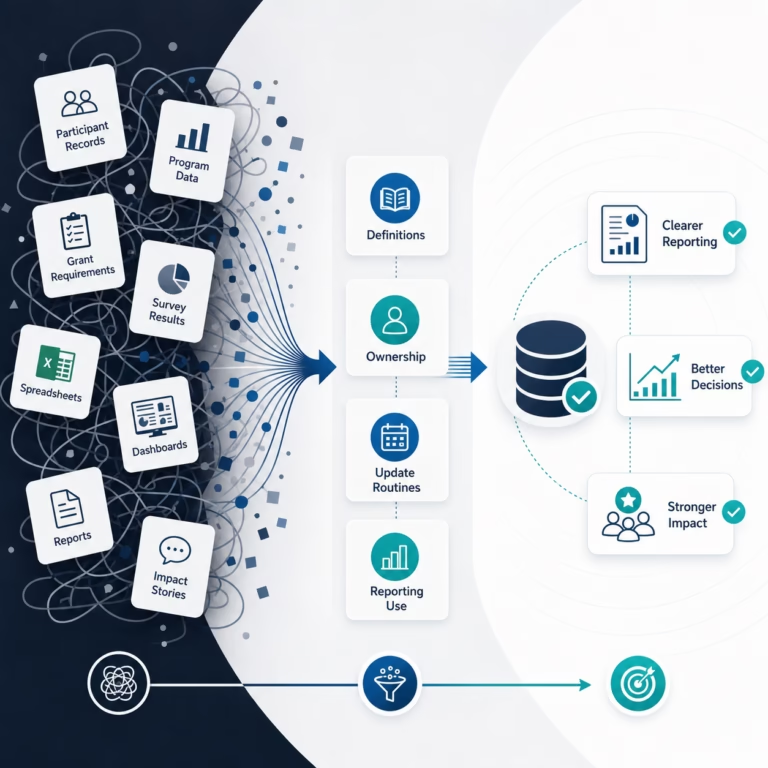
They have program attendance. Participant notes. Grant requirements. Survey results. Service counts. Donor records. Outcomes. Stories. Reports. Spreadsheets. Dashboards. Forms. Files.
The problem is that the data is often inconsistent, scattered, or disconnected from decisions.
One team defines a participant one way. Another defines completion differently. A grant report uses one measure. A board report uses another. A program lead knows which spreadsheet is current, but no one else is fully sure.
The data exists. The discipline around the data is weak.
That is where reporting starts to break down.
Practical data discipline means fewer assumptions
Good data discipline does not have to be complicated.
It means the organization has clear answers to basic questions:
- What are we tracking?
- Why are we tracking it?
- How is it defined?
- Where does it live?
- Who owns it?
- How often is it updated?
- How is it used in reporting or decisions?
If those answers are unclear, even a strong tool will struggle.
A dashboard built on unclear definitions will only make confusion look polished. AI used against inconsistent data will produce confident summaries of weak inputs. A new platform added without ownership will become one more place information has to be maintained.
The first step is not more technology.
The first step is agreement.
The right level of structure matters
Small and mid-sized nonprofits do not need enterprise complexity to improve impact visibility.
They need a structure that matches their size, staffing, and reporting reality.
That may mean defining a small set of core KPIs. It may mean agreeing which programs connect to which goals. It may mean assigning owners for monthly updates. It may mean documenting how grant outcomes are tracked. It may mean deciding where impact stories are captured and how they support reporting.
None of this requires a large data team.
It requires operating discipline.
The goal is not to track everything. The goal is to track the right things clearly enough that the organization can use the information with confidence.
A simple test for data discipline
Pick one important report your organization produces.
A board update. A grant report. A leadership dashboard. An annual impact summary.
Then ask:
- Are the measures clearly defined?
- Does everyone use the same definitions?
- Is the source of truth clear?
- Is ownership assigned?
- Is the data updated on a known schedule?
- Can the numbers be connected to programs, goals, grants, and stories?
- Would the report still be possible if one key staff member were unavailable?
If the answer is no, the issue is not just reporting.
It is data discipline.
What better looks like
A stronger nonprofit data model is not necessarily large. It is clear.
The organization knows which data matters most. Staff understand what they are responsible for maintaining. Leaders know which numbers can be trusted. Reports use consistent definitions. Stories and data can be connected. Funding, programs, outcomes, and reporting needs are easier to trace.
That kind of structure changes the conversation.
Instead of asking, “Where is the latest version?”
The organization can ask, “What are we learning?”
Instead of spending time reconciling numbers, leaders can spend more time making decisions.
That is the point.
Where Elroos Technology fits
Elroos Technology helps nonprofits build practical data discipline without unnecessary complexity.
The work connects goals, programs, grants, KPIs, data, systems, workflows, governance, reporting needs, and impact stories into a structure the organization can understand and maintain.
That structure supports better reporting, clearer decision-making, and more credible impact communication.
For organizations using Track Impact Now, the same discipline helps define how goals, programs, grants, KPIs, and impact stories should be organized in the platform so the system reflects the way impact needs to be tracked and communicated.
The goal is not a bigger data operation.
The goal is a clearer one.
Bottom line
Nonprofits do not need to become enterprise data organizations to improve impact reporting.
They need practical discipline around the information that matters most.
Clear definitions. Clear ownership. Clear update routines. Clear reporting use. Clear connection between programs, funding, outcomes, and stories.
That is what makes data useful.
And useful data is what helps leaders see what is working, explain progress, and make better decisions.
