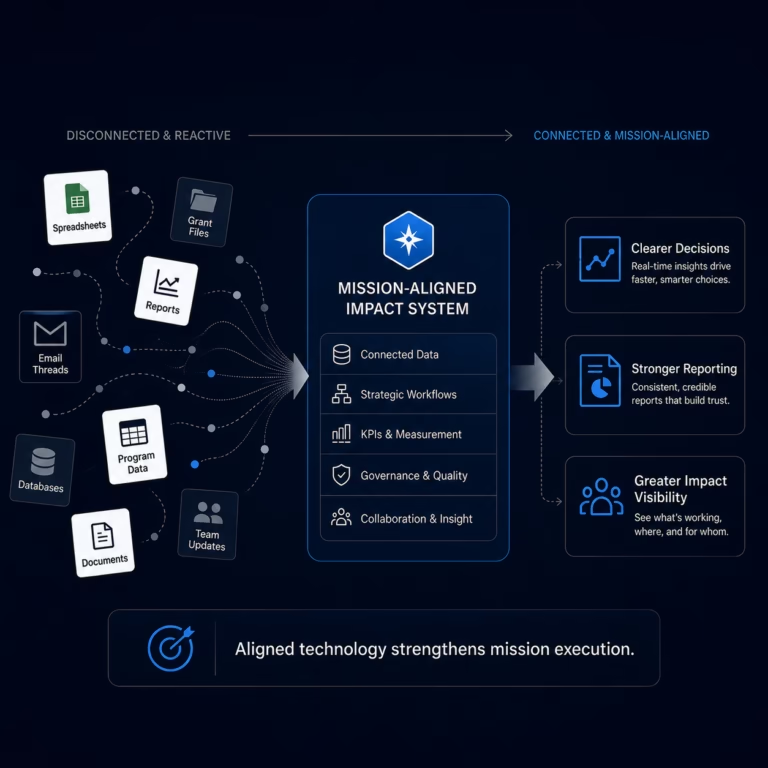
A nonprofit can have modern tools and still struggle to see what is working.
It can have a CRM, spreadsheets, dashboards, grant systems, email platforms, survey tools, and AI pilots, yet still lack a clear view of impact.
That is because technology alone does not create clarity.
Technology only matters when it strengthens mission execution.
If a system does not help the organization deliver, track, manage, decide, or communicate more clearly, then it is not solving the real problem. It may even be adding another layer of work.
The tool is rarely the starting point
Nonprofits are often pushed toward tools before the operating question is clear.
A dashboard is requested before the reporting model is defined.
A new platform is considered before ownership is clear.
AI is explored before data and workflow discipline exist.
A system is added before anyone agrees what needs to be tracked.
That is how technology becomes another disconnected place where information lives.
The better question is not, “What tool should we buy?”
The better question is, “What work needs to become clearer, more reliable, or easier to sustain?”
That question changes the conversation.
Technology should support the work, not become the work
The purpose of technology in a nonprofit is not to look modern.
It is to support the work of the organization.
That may mean helping program teams capture consistent information. It may mean helping leadership see progress sooner. It may mean helping development teams connect funding to outcomes. It may mean making board and funder reporting less manual. It may mean giving staff a better way to manage information that is currently scattered across spreadsheets, documents, and memory.
Technology earns its place when it makes mission execution stronger.
If it does not reduce friction, improve visibility, support decisions, or make reporting more credible, its value should be questioned.
A practical test for nonprofit technology
Before adding or replacing a system, ask five questions.
- What decision, report, workflow, or outcome will this improve?
- What information needs to be connected for this to work?
- Who will own the data, updates, and ongoing use?
- What process will change, and is the team ready for that change?
- How will we know this improved mission execution?
If the answers are unclear, the technology decision is premature.
The issue may not be the tool. The issue may be the missing structure around the tool.
The hidden risk of disconnected systems
Every disconnected tool creates a small burden.
Staff have to remember where information lives. Reports require manual reconciliation. Leaders get partial views. Data definitions drift. Workflows depend on the person who knows the workaround. Over time, the organization builds a technology environment that technically functions but does not create enough clarity.
This is where many nonprofits get stuck.
They do not necessarily need more technology. They need better alignment between mission, programs, data, workflows, reporting, governance, and systems.
That is impact infrastructure.
What better looks like
A stronger technology environment is not always bigger.
It is clearer.
The organization knows what each system is for. It knows which information belongs where. It knows who owns updates. It knows how data supports reporting. It knows how systems connect to programs, grants, KPIs, stories, and decisions.
When that structure exists, technology becomes easier to evaluate.
A useful system supports the operating model.
A weak system creates workarounds.
A missing system creates gaps.
An unnecessary system creates noise.
The goal is not to use more tools. The goal is to make the right tools support the right work.
Where Elroos Technology fits
Elroos Technology helps nonprofits evaluate technology through the lens of impact, reporting, governance, and mission execution.
The work starts with the structure: what needs to be connected, what information matters, who owns it, how workflows should operate, and how reporting needs to support decisions.
From there, technology choices become more practical.
Systems can be improved. Workflows can be redesigned. AI opportunities can be assessed responsibly. Track Impact Now can be used where a structured platform is the right fit for connecting goals, programs, grants, KPIs, and impact stories.
The point is not technology for its own sake.
The point is technology that helps the organization manage impact more clearly.
Bottom line
Technology should not be measured by how new it is.
It should be measured by what it makes possible.
Does it help staff work with less friction?
Does it help leaders see what is happening?
Does it support stronger reporting?
Does it connect programs, funding, data, and outcomes?
Does it make impact easier to manage and communicate?
If the answer is yes, technology is doing its job.
If the answer is no, the organization may not need another tool. It may need a clearer structure behind the tools it already has.
