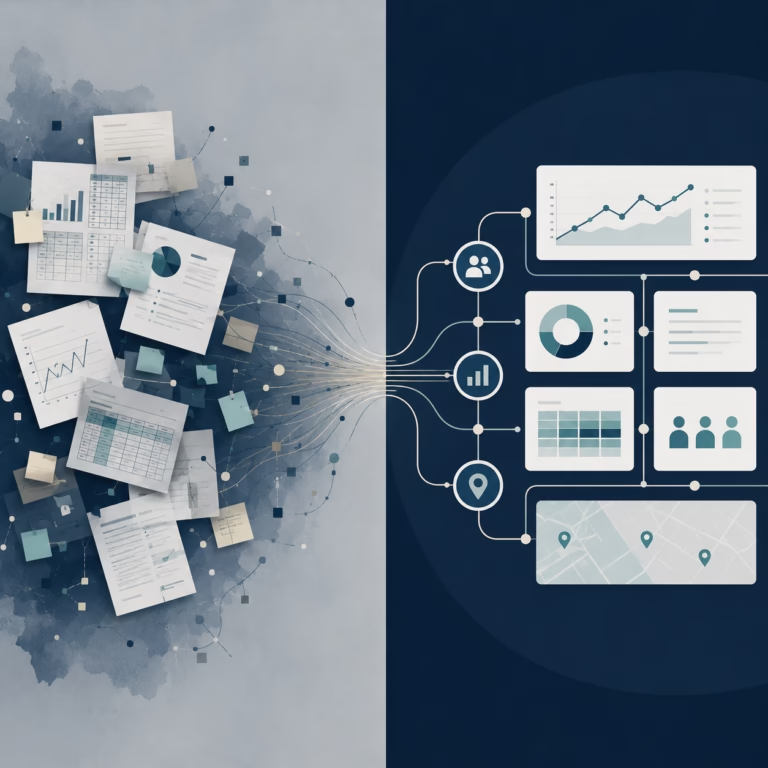
There is a familiar reporting scramble inside many nonprofits.
A board meeting is coming up. A funder report is due. Leadership wants a clearer picture of progress. Someone asks for the latest impact numbers, program updates, grant outcomes, and a few strong stories.
Then the search begins.
One person checks spreadsheets. Another looks through grant files. Program staff are asked for updates. Someone pulls old reports. Someone else searches emails for a participant story. The final report gets finished, but only after too much chasing, reconciling, rewriting, and guessing.
That is not a reporting problem.
That is an impact infrastructure problem.
The report is where the problem shows up
Most nonprofits do not struggle with impact reporting because they lack meaningful work.
They struggle because the evidence of that work is not managed in a connected way.
The goals are in one place. Program activity is somewhere else. Grants have their own requirements. KPIs are tracked inconsistently. Stories are collected separately from the data. Reporting depends on the people who know where everything is.
That works until someone needs a clear answer quickly.
Then the organization realizes that its impact is real, but its visibility is fragile.
The cost is not just time
The obvious cost is staff time. Reports take too long. Updates require too much manual effort. People get pulled into last-minute information gathering.
But the bigger cost is leadership clarity.
When impact information is scattered, leaders cannot easily see what is working, where support is needed, which programs are moving the needle, or how funding connects to outcomes. The organization may be doing strong work, but the picture is harder to explain than it should be.
That weakens board reporting. It complicates funder communication. It makes planning harder. It also puts too much organizational knowledge in people’s heads instead of in a structure the organization can trust.
What better looks like
Better impact reporting starts before the report is due.
A stronger organization can answer a few basic questions without starting from scratch:
- What goals are we trying to advance?
- Which programs support those goals?
- Which grants are connected to the work?
- Which KPIs show progress?
- Where does the data live?
- Who owns updates?
- Where are impact stories captured?
- What reports need to be produced, and how often?
These are not technical questions first. They are operating questions.
The answer is not always a new system. Sometimes the first step is simply deciding what should connect, who owns it, and how it will be maintained.
That is the shift from assembling impact to managing impact.
A quick test for your organization
Ask this:
If a board member, funder, or executive asked for a clear impact update today, how much of the answer could you produce from a trusted structure, and how much would depend on searching, emailing, and asking around?
If the answer depends heavily on searching and asking around, the reporting process is carrying too much risk.
The issue may be data quality. It may be workflow. It may be ownership. It may be disconnected tools. It may be unclear KPIs. Most often, it is a mix.
But the pattern is the same: the organization is trying to communicate impact without a strong enough structure behind the evidence.
Where Elroos Technology fits
Elroos Technology helps nonprofits build that structure.
The work connects goals, programs, grants, KPIs, systems, workflows, governance, reporting needs, and impact stories into a practical model for tracking, managing, and communicating impact more clearly.
That means the organization is not just improving a report. It is strengthening the way impact information is organized, maintained, and used.
For organizations that need a platform to support that structure, Track Impact Now helps connect goals, programs, grants, KPIs, and impact stories in one structured system.
The point is simple:
Strategy defines the structure. Implementation makes it usable.
The practical starting point
Start with the reports that matter most.
Board updates. Grant reports. Leadership reviews. Donor communications. Annual reports. Program reviews.
Then work backward.
What information do those reports require?
Where does that information live today?
Who owns it?
How often is it updated?
Is it connected to goals, programs, grants, KPIs, and stories?
Can someone else find it without asking the same three people every time?
Those answers will show where the structure is strong and where it is exposed.
Bottom line
Impact should not be reconstructed under pressure.
It should be managed through a clear structure that helps leaders see progress, staff understand what matters, funders receive stronger evidence, and the organization communicate its value with confidence.
The goal is not more reporting work.
The goal is to make meaningful work easier to see, manage, and communicate.
